Insight

For many organisations, sustainability is no longer just about good intentions. It needs to be visible, practical and measurable.
Water refill stations can play a useful role in that shift. They give people a convenient alternative to bottled water, reduce reliance on single-use plastic and help organisations turn everyday refilling behaviour into evidence.
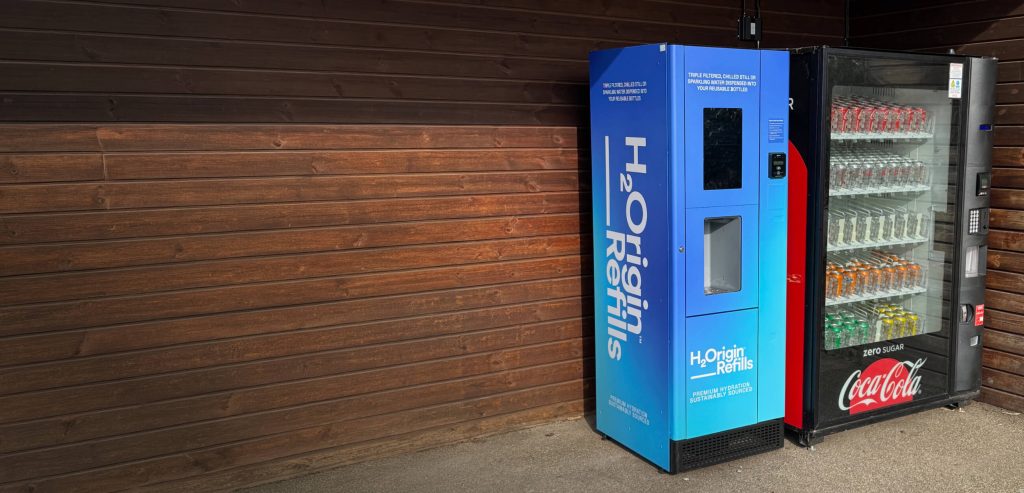
H2Origin Refills provides smart connected water refill stations designed to deliver filtered, super-chilled water in public spaces, backed by live data that shows the difference refilling can make.
Bottled water carries an environmental impact beyond the bottle itself.
There are plastic production, transportation, refrigeration, disposal, and waste management. Even when bottles are recycled, the wider lifecycle still creates an avoidable impact.
H2Origin’s mission is to reduce the environmental impact of imported bottled water by bringing chilled, filtered water directly to refillable bottles. The company’s message is clear: fill your bottles, not the land.
For organisations with high-footfall sites, this is an opportunity. If people are already buying bottled water on-site, a refill station can offer them a better alternative.
A smart refill station does more than dispense water.
H2Origin says its stations capture live usage data, plastic savings, and financial savings, providing partners with transparent ESG reporting.
That data matters because it helps organisations understand how the station is being used and what impact it is having over time.
Instead of saying “we are trying to reduce plastic”, organisations can show:
This turns hydration infrastructure into something measurable.
Many organisations now need to evidence their sustainability activity more clearly.
Stakeholders want to know what is actually changing. Staff, visitors, customers, students, patients and local communities are increasingly aware of environmental claims. A visible initiative is useful, but one backed by data is stronger.
H2Origin’s positioning is built around this idea: making premium hydration accessible, sustainable and measurable.
That is why water refill stations can work well as part of an ESG programme. They are easy for people to understand, simple to engage with and capable of producing ongoing usage data.
Refill stations are most useful where there is high footfall and regular consumption of bottled water.
H2Origin says it works with organisations in leisure, health, education and travel to find optimal placement locations for its smart connected water refill stations.
Potential locations include:
The best locations are places where people need water regularly and where bottled drinks are currently the default option.
The sustainability case is important, but the user experience still matters.
People are more likely to refill if the water is appealing and the station is easy to use. H2Origin highlights filtered, super-chilled water, large chilling capacity and a hygienic design that allows larger bottles to be used without contact with the dispense head.
That matters because a refill station only creates impact if people use it.
A poor refill experience will not change behaviour. A reliable, visible and appealing station has a much better chance of making refilling the normal choice.
H2Origin also highlights bespoke branding opportunities to help partners promote the service to users.
This is useful because refill stations are not just functional assets. They are also communication points.
Branding can help organisations explain:
This makes the station part of the organisation’s wider sustainability story.
Installing a refill station is not only a facilities decision. It is a behaviour change opportunity.
For people to move away from single-use plastic bottles, the alternative needs to be convenient, visible and reliable.
A smart refill station can support that by making refilling easy and by showing the collective impact over time.
That is especially powerful in places where large numbers of people pass through the same space every day. Small individual actions can add up to a measurable collective result.
H2Origin’s stated mission is to build a nationwide network of premium, smart connected water stations capable of delivering 50 million refills a year by 2030.
That ambition gives the proposition a clear direction. The focus is not only on selling refill stations but also on building a broader refill network that helps more people choose refilling over bottled water.
For partners, that means participating in a visible environmental initiative with measurable impact.
Smart water refill stations can help organisations make hydration more sustainable, more accessible and more measurable.
They reduce reliance on bottled water by giving people a better refill option. They support ESG reporting through live usage and impact data. They also create a visible sustainability initiative that people can interact with every day.
For organisations looking to reduce plastic waste and demonstrate practical environmental action, smart refill stations offer a clear, measurable starting point.
H2Origin Refills works with partners across education, health, leisure and travel to place smart connected water refill stations where they can have the greatest impact. To explore a suitable location for your organisation, get in touch with the team.
A smart water refill station is a refill point that dispenses drinking water and uses connected technology to capture data on usage and environmental impact.
H2Origin states that every station captures live usage data, plastic savings, and financial savings, providing partners with transparent ESG reporting.
H2Origin works with organisations in sectors including leisure, health, education and travel to identify suitable locations for smart connected water refill stations.
H2Origin stations deliver filtered, super-chilled water, sourced from a mains connection
H2Origin is working to build a nationwide network of premium, smart connected water stations capable of delivering 50 million refills a year by 2030.