Insight
The government’s proposed changes to school food standards are putting a welcome spotlight on what children eat and drink throughout the school day.
But while much of the conversation has understandably focused on food quality, sugar reduction and healthier menus, there’s another important consideration.
How do we make drinking water more appealing to pupils?
At H₂Origin Refills, we believe this deserves much more attention.
For too long, drinking water provision in schools has been treated as a basic facility requirement rather than an opportunity to improve the daily experience of pupils and staff.
The latest government research offers an opportunity to change that.
On 29 October 2026, the Department for Education published findings from its feasibility pilot examining proposed updates to school food standards in England.
The proposals aim to improve children’s diets, including reducing their consumption of sugar through drinks.
An important element is the availability of free, fresh drinking water in dining areas and wherever food is served.
The pilot also explored tighter restrictions on sugary drinks, including fruit juices and other products that can contain significant amounts of sugar.
The findings were particularly interesting in secondary schools.
While primary schools were generally more accepting of the changes, some secondary pupils were less enthusiastic about losing familiar drinks.
In one school, water consumption increased after changes to the drinks available, but pupil dissatisfaction remained.
For the subsequent consultation, the proposed secondary school drinks standard was adjusted to allow certain sugar-free flavoured waters and no-added-sugar fruit-flavoured drinks.
The findings raise an important question.
If we want children to make healthier drinking choices, are schools doing enough to make those choices attractive?
Walk into many school dining halls and you’ll find the familiar water jug.
Elsewhere, there may be a basic stainless-steel drinking fountain positioned along a corridor or near the toilets.
These facilities provide access to drinking water and can serve their purpose perfectly well.
But there’s a difference between making water available and encouraging pupils to drink it regularly.
Think about the environment children experience outside school.
Modern cafés, leisure centres and public spaces increasingly place emphasis on presentation, accessibility and convenience.
Yet in some schools, drinking water provision has changed very little over the years.
If we’re asking pupils to choose water over drinks they previously enjoyed, shouldn’t we also be thinking about how that water is presented?
Children make choices based on what is available, convenient and appealing.
School hydration facilities should reflect this.
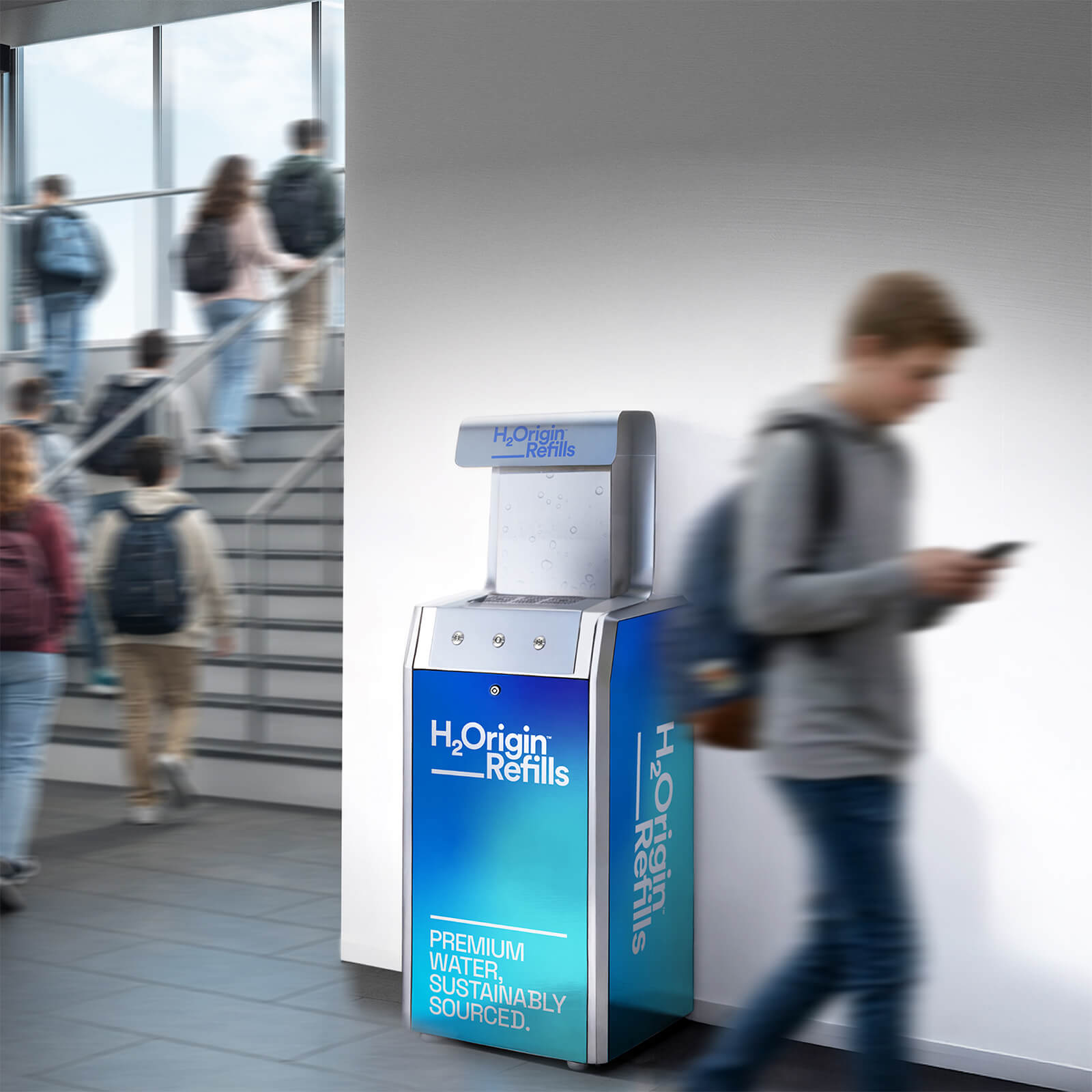
A well-positioned, modern water refill station can become a visible part of the school environment rather than something pupils have to go looking for.
There are several practical considerations.
Accessibility: Can pupils easily refill their bottles during breaks and lunchtimes?
Capacity: Can the equipment cope with large numbers of pupils wanting water at the same time?
Quality: Is the water consistently fresh, filtered and chilled?
Presentation: Does the facility look like something pupils and staff would actively want to use?
Reliability: Is the equipment maintained and available when needed?
These are important questions for schools reviewing their drinking water facilities.
They also matter for teachers and support staff, whose access to convenient hydration shouldn’t be overlooked.
At H₂Origin Refills, we’ve developed our approach around a simple principle.
Providing water is one thing. Creating a better hydration experience is another.
Our modern refill stations offer schools an alternative to relying solely on traditional jugs and basic drinking fountains.
Designed for busy environments, our high-capacity stations can provide up to 150 litres of chilled, filtered water per hour.
They support reusable water bottles, incorporate smart monitoring technology and are backed by a managed servicing and maintenance approach.
For schools, this means water provision can be considered as part of their wider facilities, wellbeing and sustainability strategies.
And for pupils, it means having access to a modern, convenient drinking water facility designed around how they use it.
The aim isn’t simply to install another piece of equipment.
It’s to make refilling a water bottle an easier, more appealing everyday choice.
There is also an environmental opportunity.
Schools across the UK are increasingly looking for practical ways to reduce waste and demonstrate their commitment to sustainability.
Encouraging reusable water bottles and providing convenient refill facilities can support efforts to reduce reliance on single-use plastic bottles.
H₂Origin’s connected refill stations also provide usage information that can help organisations monitor their refill activity and understand its environmental impact.
For schools and multi-academy trusts working towards sustainability objectives, this creates an opportunity to connect everyday behaviour with measurable progress.
It also gives pupils a practical example of how small, repeated actions can contribute to wider environmental goals.
The government’s latest findings highlight the importance of making healthier drinks a normal part of school life.
However, regulations alone won’t determine whether pupils embrace those choices.
Schools also need to consider how they encourage positive habits.
That means looking beyond the minimum requirements and asking whether existing facilities are genuinely fit for purpose.
Traditional drinking fountains and water jugs will continue to have a place in some settings.
But where schools are investing in their facilities and reviewing how they support pupil wellbeing, there is a real opportunity to think differently.
Better access. Better presentation. Reliable facilities. A positive experience for pupils and staff.
These should all be part of the conversation.
Because if we’re serious about improving hydration in schools, we should be serious about how we provide it.
At H₂Origin Refills, we work with education providers to improve drinking water provision through modern, high-capacity refill infrastructure.
Whether you’re reviewing facilities across a single school or an entire academy trust, we can help you explore a more effective approach.
Book a Hydration Review and discover what better drinking water provision could look like for your school.
Doing Water BETTER.
H₂Origin Refills
www.h2originrefills.com